
AboutKnowledge Without Borders
AN INVITATION TO READ
How to prepare content for distance education
This book was written for you, teacher or content specialist, who faces the challenge of preparing content for distance learning courses. It describes the main stages of producing content for distance education, starting with understanding the students, the institutional context, and their learning needs.
It also addresses how to plan, develop, and validate different types of content and their respective learning activities.
Transformação digital na educação
This is essential reading for those seeking to understand and implement digital transformation in educational institutions in a structured and multidimensional way. The book explores how digitalization can influence the formulation of strategic objectives, resource allocation, risk management, and progress monitoring, ensuring alignment with long-term organizational goals and promoting social sustainability.
The work also investigates how digital transformation intersects with crucial issues of digital equity and inclusion, providing guidelines for organizations to navigate the complexities of the digital age responsibly. Intended for managers, leaders, and decision-makers, this guide offers practical strategies and valuable insights to lead educational institutions towards a sustainable and ethical digital future.
Metodologias inov-ativas na educação - edição atualizada
This book was written for all those who work in face-to-face, distance, and corporate education and seek innovation in educational practices.
It presents practical cases of the adoption of innovative methodologies in national and international organizations and the disruptive possibilities of their application in schools, universities, and companies. It also provides easily accessible and applicable strategies so that you, the reader, can experience a sample of innovative methodologies in your own field of work.
There are four groups of teaching-learning methodologies:
- Creative methodologies focused on student protagonism;
- Agile methodologies focused on time management;
- Immersive methodologies centered on simulating reality;
- Analytical methodologies directed at analyzing the data produced in the student's interaction with people, content, and tools.
Essential reading for those who work or wish to work with face-to-face, distance, or corporate education.
Design thinking: inovação e propósito
In its second edition, Design Thinking: Innovation with Purpose revisits and expands the role of Design Thinking (DT) as a catalyst for significant change in complex realities. More than a problem-solving methodology, DT reaffirms itself as a philosophy that places the human being at the center of the innovation process, driving the achievement of individual and collective purposes, as well as the construction of innovative, ethical, and sustainable solutions.
In this work, the theme is addressed in a practical way, with dialogical language and permeated with visual resources, without losing its theoretical foundation. The objective is to offer readers an overview of the approach and a set of strategies applicable to real-world contexts.
DT has been successfully applied in companies and universities for over 20 years to generate new products, processes, and services. It has gained followers in public organizations, private organizations, the third sector, and educational institutions, as it helps prepare people to face contemporary challenges in all their phases.
Written for an audience eager for innovative strategies, this book is an accessible guide for managers and researchers in the areas of Leadership, Innovation, Education, Design, Knowledge Management, and Administration.
Design instrucional para professores
After several projects and publications focused on instructional design, we present this book to educators in general and, particularly, to teachers, those who are on the front lines of education and who increasingly recognize the need to update their original training to meet contemporary challenges.
The book is structured in eight chapters. The first two provide the reader with an overview of the fundamentals of instructional design (ID) and its steps for building educational solutions.
The third chapter places the learner at the center of the process, while the fourth provides an overview of learning theories, as well as ID from a pedagogical, andragogical, and heutagogical perspective.
The fifth and sixth chapters go to the heart of so-called micro ID and explore the design of learning activities and educational content. The seventh chapter addresses media and technologies, and the eighth – and final – chapter is dedicated to evaluating learning and the proposed solution from the ID perspective.
Throughout the book, we seek to alternate between tradition and innovation in instructional design; that is, we bring together guidelines tested and proven by researchers and practitioners throughout history, while also pointing to innovations that can make a difference in education in the present and the future.
DI 4.0 – Inovação na educação corporativa
In recent decades, the digital transformation movement has only increased the challenges in the field of corporate learning. A new professional environment, a new set of skills to be developed, and a multitude of new technological resources give rise to new responses, for which conventional, tried-and-tested solutions no longer work.
Aimed at human resources professionals, managers, coordinators and analysts of training & development, professionals from corporate universities, learning solution providers, and education specialists in general, this book is dedicated to those who have the responsibility of training/empowering professionals to act in accordance with the organization's strategic objectives.
The author updates the concept of Instructional Design (ID), offering a mix of tradition and innovation that combines classic instructional design (ADDIE model, Design Thinking, Learning Experience Design, and User-Driven Instructional Design). By presenting ID 4.0, she aligns the human perspective with business strategy, for professionals who wish to meet the challenge of innovating in corporate education.
Design instrucional na prática
Since its release in 2008 by Pearson Publishing, this book remains one of the most widely used by digital design and distance education professionals in Brazil. It is a practical, comprehensive, objective, and complete book that serves as a true guide for developing online courses.
The main topics covered include:
- Concepts and fundamentals of instructional design
- Instructional design for e-learning
- The ADDIE model and fixed, open, and contextualized instructional design
- Contextual analysis
- Design of learning units
- Specification in instructional design: scripts and storyboards
- Content design
- Human-computer interface design
- Interaction design
- Feedback and evaluation design
- Design of virtual environments
- Costs, deadlines, and quality
- Project management
Design instrucional contextualizado - edição atualizada
In this twentieth-anniversary commemorative edition, revised and updated, Andrea Filatro presents a new approach to planning and implementing technology-mediated educational activities, including data analytics and artificial intelligence. Her goal is to broaden the scope of instructional design. The author proposes that this design incorporate technological innovations to go beyond established teaching models, integrating informal, autonomous, and cooperative learning into real instructional situations, as well as authentic experiences that meet the demands of the world of work and a society undergoing profound transformation.
The main themes covered in the book are:
- The current educational landscape
- Society, education and technology
- Digital education
- Instructional design
- Dominant teaching-learning paradigms
- The role of context in instructional design
- The contextualized instructional design development model
- The role of the instructional designer
- Perspectives
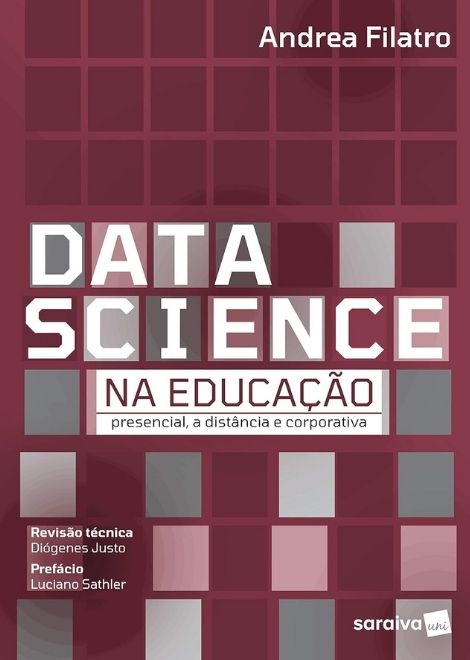
Data science na educação
For readers who follow the author's publications, this is another title "in tune" with recent innovations in research and practice in education.
The text supports the reader in the challenge of building their own framework of ideas regarding the new realities provided by Data Science and Artificial Intelligence and their application in schools, universities, corporate universities, and other face-to-face, distance, and hybrid contexts.
Topics covered:
- Concept of Data Science, its components, processes, and applications in the educational context
- Data mining techniques, Educational Data Mining, KDD, data visualization, and dashboards
- Use of data and evidence to support strategic and pedagogical decisions in education
- Big Data, governance, and data protection
- Data analytics and Learning Analytics
- Artificial intelligence in education
- Smart education
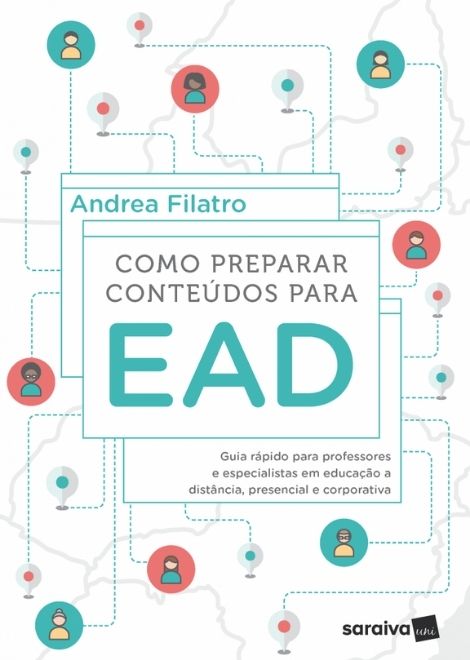
Como preparar conteúdos para EAD
This book, packed with infographics, describes the major stages of content preparation – starting with understanding the students, the institutional context, and learning needs – and including how to plan, develop, and validate various types of content and their respective learning activities. It's a quick reference for teachers, content creators, and anyone interested in producing digital and multimedia teaching materials.
Summary
- Introduction: Fundamental concepts of distance education, content preparation, and its relationship with instructional design.
- Where to begin? Student profile, institutional context, learning styles, and identification of educational needs.
- How to plan content for distance education? Planning units, learning objectives, roles, media, technologies, assessment, and cognitive load.
- How to develop content for distance education: Strategies for didactic writing, curation, hypertext, graphics, slides, podcasts, video lessons, and activities.
- How to validate content for distance education? Validation processes for video lessons, content published on the LMS, and quality assurance.
- Closing: Final summary and concluding guidelines on the production of content for distance education.
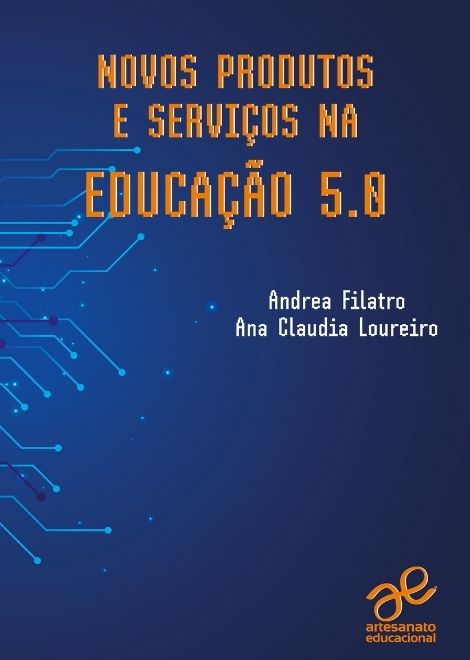
Novos produtos e serviços na Educação 5.0
Do you know what Education 5.0 is? Discover what this concept means based on the most innovative educational products and services, including mixed reality tools, intelligent tutoring systems, remote labs, robotics, and the Internet of Things.
Summary
- Education 5.0
- Overview of new products and services for Education 5.0
- The profusion of new products and services in Education 5.0
- Challenges of new products and services in Education 5.0
- Innovation ecosystem
- A word about the change in mindset in education
- Overview of new products and services in Education 5.0 (alphabetical order)
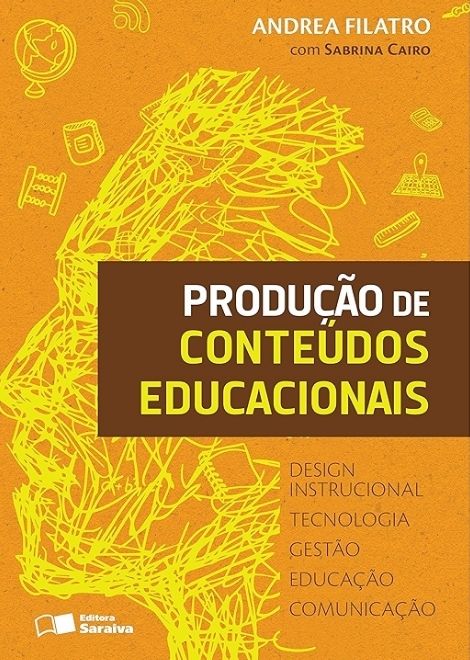
Produção de conteúdos educacionais. (impressão sob demanda)
This book was written by Andrea Filatro, with the collaboration of Sabrina Cairo, then editor at Saraiva, with the aim of gathering as much guidance as possible on the production of content for distance education and face-to-face education supported by technology.
Released in 2016, the book offers a multidimensional approach, in which technoscientific (related to the content itself), pedagogical, communicational, technological, and organizational aspects are thoroughly examined, offering the reader a broad and interdisciplinary view of the subject.
In addition to a robust theoretical foundation, the book includes practical chapters on planning, authoring, scriptwriting, and producing various types of content in print, audio, video, and multimedia media.